
Edclicking
By Dr. Harry Tennant
Edclicking
by Harry Tennant


Show posts with most recent comments
Keywords:
7 Habits of Happy Kids (1)
ads (3)
Aeries (1)
after action review (1)
after-action review (1)
API (1)
Behavior Manager (26)
behavior policies (1)
Behavior Questionnaires (2)
blogs (1)
carrots and sticks (3)
challenge (2)
change (1)
character builders (1)
check for use (1)
Check In/Check Out (1)
checklist (1)
child-driven education (1)
classroom management (1)
classroom mangement (1)
coaching (1)
code of silence (1)
collaborative learning (6)
confirmation bias (1)
continuous improvement (79)
cost savings (7)
creativity (1)
deliberate practice (3)
discipline (2)
Discipline Manager (2)
Dragon (1)
duty to warn (1)
Edclick (1)
Edison (1)
education (1)
email bankruptcy (1)
email-to-SMS (1)
enthusiasm (2)
entrepreneurship (3)
evidence-based practices (1)
experiments (1)
FAQ: Behavior Manager (63)
FAQ: Community Service Manager (1)
FAQ: Intervention Manager (7)
FAQ: Lesson Plan Manager (2)
FAQ: Testing Manager (6)
FAQ: Tutoring Manager (3)
function of behavior (1)
funding (1)
getting started (24)
habits (3)
improvement log (1)
info hub (1)
Innovation (1)
Intervention Manager (1)
interventions (1)
Isaac Asimov (1)
ISV Partner Program (1)
Jamie Oliver (1)
knowedge work (1)
lesson plans (1)
liberal education (1)
measurement (1)
mentoring (3)
merit points (1)
mission (1)
mitra (1)
motivation (1)
motivations (1)
NCLB (1)
nutrition (1)
one-click merits (1)
online instruction (1)
online learning (2)
parental involvement (4)
PBIS (10)
PBL (3)
PDCA cycles (1)
Pearson (1)
perfection (1)
planning (1)
positive feedback (1)
PowerSchool (1)
Practice Classroom Management Skills (2)
Practice in Classroom Management Skills (1)
prevention (11)
process improvement (1)
processes (1)
Professional learning communities (1)
progress (4)
projects (1)
punishment (1)
reflection (4)
Responsible-Motivated-Engaged (14)
Restorative Discipline (1)
restorative justice (1)
rewards (1)
RtI (1)
rubric (1)
run chart (2)
School Safety Manager (12)
school violence (11)
science of education (1)
self-serving bias (1)
service and fees (11)
small groups (1)
social skills club (1)
star chart (1)
STEM (5)
student imports (1)
success (3)
success story (3)
sucess story (1)
super rich educators (1)
supports (1)
surprise success (1)
surprises (1)
tardies (1)
teach expectations (1)
teaching effectiveness (1)
Testing Manager (1)
thank you teachers (1)
time saving (3)
tips (18)
tweak (2)
using discipline manager (8)
using School Site Manager (7)
values (1)
virtual classrooms (1)
volunteers (3)
waste (2)
wealth (1)
weightloss (1)
wikis (6)
Archive:
2010
November (4)
December (4)
2011
February (8)
March (13)
April (12)
May (4)
June (2)
July (12)
August (12)
September (8)
October (9)
2012
January (5)
February (12)
March (10)
April (12)
May (11)
June (5)
July (1)
September (2)
2013
January (22)
February (29)
July (6)
August (14)
November (1)
2015
July (2)
August (5)
September (4)
October (1)
2017
October (2)
November (7)
December (2)
2018
January (3)
February (12)
March (4)
April (1)
August (11)
2021
February (1)
Posts 1 - 79 of 79
|
Monday, December 4, 2017 Improving student behavior schoolwide
Let's say your school has a big problem with tardies. It seems that tardies are out of control. What do you do? A quick search of tardy solutions reveals candidates.
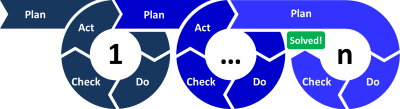
There are lots of things to try. Some might work, some might not. Some may reduce tardies a little, others might reduce tardies a lot. We could just start trying solutions randomly but there is a more orderly way to do it. It's called the PDCA cycle and is widely used outside of education for continuous improvement. PDCA stands for Plan-Do-Check-Analyze.
It's hard to predict how well solutions to complicated problems are going to work in your environment. What worked for others may not work for you, and vice versa. So, experiment but expreriment in a orderly way so you can learn along the way. The key to success is to run lots of experiments quickly and cheaply in order to discover the right solution(s). Repeat the PDCA cycle until the problem is solved. Do it in an orderly fashion following the simple PDCA cycle, keeping track of your plans, results and analyses for each cycle. You will be glad you documented your attempts and progress when your superintendent asks, "Hey, how did you solve that tardy problem?" Posted at 12:00 AM (permalink)
0 Comments View/Leave Comment
|
|
Wednesday, November 15, 2017 How can behavior be improved?The traditional view of school discipline is that punishment will serve as a deterrent. If a student is not deterred, step up the punishment. The extreme case is to expel an incorrigible student. The traditional approach works for most students. But for the students who do not respond, there may be serious consequences. Missing school through suspensions and expulsions leads to poor academic performance and often to dropping out. It also leads to negative attitudes toward shool when the student does return. Further, for students who may not have learned the rules of behavior and socialization in their home life, teaching through catching mistakes and punishment is a brutish way to teach. As a result, positive behavior supports (PBIS) continues to gain support as a better alternative. I treats school misbehavior as primarily a knowledge and skills issue. Teach behavior expectations, provide frequent feedback, emphasizing positive feedback and keep track of students' mastery of the knowledge and skills. When a student misbehaves, try to figure out why. Lack of knowledge? Desire for attention? Escape from a situation or responsibilty? Tailor the response to the motivation. A few things are left out of the story. With both the carrots approach (PBIS) and sticks approach (traditional discipline) the assumption is that the misbehavior should be corrected by the student. But take tardies. They may be caused by crowded hallways, malfunctioning lockers or classes being too far away from one another. Another common trigger of student misbehavior is poor teaching skills. Boring, unengaging teachers are likely to see students invent new ways to engage their minds in the classroom. Teachers who lack "withitness" skills often miss opportunities to nip off task behavior in the bud, then things get out of hand. A third issue is parent's attitudes. If parents are casual about school hours, for example, tardies may be common. Again, not exactly the fault of the student. So, what's to be done? First, recognize that conditions that are not under the student's control can contribute to infractions. Second, gather data that gives you insight into what's going on. Are there teachers with abnormally high rates of office referrals? Why? Are there systemic problems like crowded hallways that cause problems? Fix them. Third, set goals for improving student behavior with a strategy for how you'll make the improvement. Then watch the numbers. If the improvement isn't coming, figure out why and try something new. Remember, student achievement is highly correlated to student behavior. It's worth the effort to make it better. Posted at 12:00 AM (permalink)
0 Comments View/Leave Comment
|
|
Monday, September 7, 2015 The change I want to seeThere are a few things that I think are important for mankind's future on the planet. They are big things so what can one person do about them? In the last two centuries we saw several big changes that seemed impossible until the changes came to pass. Slavery. Women's right to vote. Women as (nearly) equal to men in the workplace. Civil rights for minorities. Civil rights for gays. Independence for European colonies. Reduction of smoking. Reduction of the birth rate. Most of these were not the result of wars. Most were the result of cultural change. And cultural change is the result of changing attitudes in one person at a time. So, what can one person do to try to bring about the change necessary to solve mankind's most important problems? First, as Gandhi said, be the change you want to see. Concerned about carbon dioxide and global warming? Reduce your own carbon footprint. You've made a one-person step toward a cultural change. After all, cultural change is nothing more or less than many one-person changes. Second, keep a log of actions you take. It will help remimd you of what you've accomplished so far, and it answers the question, what have you done lately? Third, give special attention to a specific focus of change. The more concentrated your focus, the more readily you'll make progress. But keep in mind the larger context where you're special focus fits in. Fourth, your example can help bring about similar changes in others. At least it may be the trigger for conversations with others to get them started in thinking about the issue. And if they have already been thinking about it, your example may help persuade them to your point of view. Fifth, question yourself. When talking with others who disagree with you, try to understand why their ideas differ from yours. This can lead to at least two useful outcomes: you may discover you're wrong or you may discover more effective ways of communicating your point of view. Sixth, advocate. If you have a strong history of making your own change, you have the credibility that authenticity gives to bolster your position. The weakness of many advocates is that they want other people to change, not necessarily themselves. Seventh, persevere. Cultural change takes time, even when you firmly believe you're on the side of the angels. People are not eager to give up their comfortable habits. People will resist what they see as threats to their personal wellbeing (often meaning economic wellbeing), regardless of benefits to mankind. But the examples above (and many others) show that it happens with perseverance. So, what do I believe are mankind's most important issues today?
Ok, that sounds good. But is this really going to change the world? Should I even bother? After all, I haven't even been successful at losing weight or getting my daily run up to a reasonable distance or even quitting my addiction to Diet Coke. How can I imagine that my feeble attempts will be of any value on such large problems? Here's the secret that will puts my mind at rest: I'm not going to change the world. Not by myself. But I can start. And another person can start. And another. We can all be persistent, we will all backslide sometimes, but we mustn't give up. And none of us can change the world. But the world changes. Cultural change takes time. But that's how it has been done. And the world changes. Posted at 12:00 AM (permalink)
3 Comments View/Leave Comment
|
|
Monday, August 10, 2015 The after action review rubric/checklist run chartI am a big fan of the after action review (AAR)...taking the time to talk about the plan, what went right, what went wrong and what to do differently...after each significant action. It is a simple and effective improvement tool from the military. We use it here at Edclick after tradeshows, big customer meetings and so on. I am also a big fan of the checklist...a simple tool to ensure you don't skip any steps in a process. One place we use checklists is in setting up systems for new customers. We don't want to inadvertantly leave any steps out. But what about situations where you have to respond on the fly and referring to a checklist would be awkward? For example, we have used checklists for the perfect discussion with a prospect at a tradeshow. It goes from what is the prospect's job to did you ask for their contact info for a follow up demo. You would be amazed at how easy it is to forget the basic stuff in the heat of the moment. For situations like this, the checklist can't be pulled out to check off items. It must be internalized. Well, how good a job do we do following an internalized checklist? I'm a big fan of the rubric. Checklists with yes/no answers are simpler so are preferable to rubrics. But in cases where a yes/no answer isn't good enough, the rubric is the thing. Rubrics can give a score to each line item. And I am a big fan of the run chart. Run charts are a great quality tool to show how you are doing in a process over time. Can we put them all together? You bet. Create a spreadsheet page where each action (as in after action review) or each assignment (as in writing assignment in school) is represented by a column. Each item in the checklist is represented by a row. If a checklist item didn't get done in a particular action/assignment, mark the corresponding cell. If you're using a rubric instead of a checklist, color code the cell green-yellow-red for a three level score or lighter to darker shades of a color for more score levels. Weather maps and topographical maps have worked out color codes to represtent a wide range of values if you need them. There you have it. The after action review rubric/checklist run chart. You can see at a glance whether you're improving with time (the run chart benefit) if your color codes are getting better as you move forward in time, left to right on the chart. You can also quickly see the rubric/checklist item that is giving you the most problems, which is the one that should receive special attention until you have it mastered. Posted at 12:00 AM (permalink)
2 Comments View/Leave Comment
|
|
Monday, August 3, 2015 Show progress with run chartsWe all want to know we are making progress. It's not just putting in the time or being busy. We want to know we are getting closer to a worthwhile goal. The game designers are fully aware of this. Progress bars, badges, levels...players are continuously reminded of their progress. And that's one of the reasons games are so compelling. A simple way to show progress is the run chart. A run chart shows the cumulative progress toward a goal over time. For example, a run chart we use in Edclick shows cumulative revenues per week. At the start of the school year, it restarts at $0. We add the payments we receive each week for the next 52 weeks. The total increases as it goes through the year. It's superimposed on the run charts for the previous several years. Another run chart is for improvements. We have a goal of 100 improvements per year. The chart is very simple: just a spreadsheet where each column represents a week. As we make an improvement we enter a brief headline for it in the column for the week it was done. Each improvement gets its own row. As we approach row 100, we close in on the goal. By distributing the improvements horizontally in columns, we track that improvements are being made on a regular basis. Does it apply to teaching? Sure. Some teachers supply students with a list of facts that students should learn in the course. Weekly formative quizzes can include questions from any of these facts, not just what has been covered this week. Chart the student's scores weekly and she sees her progress: a set of scores that increases from left to right. And since quiz questions can come be about any of the facts in the course, students are motivated to review everything before each quiz, inproving retention. Posted at 12:00 AM (permalink)
0 Comments View/Leave Comment
|
|
Tuesday, January 1, 2013 Start smallHere it is, New Year's Day. I've been meaning to get back to blogging for a while. Today seems like a good day for new beginnings. What's been holding me back? I've been busy but probably a more significant impediment is the idea of re-committing to blogging. They say that when your goal is (or seems) too large, your amygdala (lizard brain) kicks in with a fear response...it has been called the amygdala hijack. And the fear response might be enough to make up excuses not to pursue the goal. So start small, under the radar of the lizard brain. So I did. Happy New Year! Posted at 11:41 AM (permalink)
0 Comments View/Leave Comment
|
|
Wednesday, September 26, 2012 Cycles within cyclesHow often does a teacher repeat what she does? A course of lesson plans is repeated once a year. The process of preparing to teach a day's lesson occurs daily. The behaviors involved in managing the activities in the classroom occur on a minute by minute basis. What is the relative importance of each of these? If a teacher's teaching is to improve, which timescale is most important to focus on? All of the timescales are necessary for effective teaching. The shortest timescales probably have the greatest effect because they are repeated most often. They also have the benefit of becoming habits, executed without conscious attention, because they are repeated so often. Ultimately, the longest timescales are the most meaningful. If a course is taught expertly on a minute by minute and day by day basis, but the course covers practical applications of astrology or phlogiston theory, the entire course is still a total waste of time. What separates the best teachers from the worst? Typically, it is the short cycles. The long cycles tend to be handled at higher levels. States mandate learning objectives. Textbooks organize bodies of knowledge. A teacher who has little control in the classroom will be ineffective. A teacher who fails to plan and prepare each day will waste students' time. A teacher who fails to provide timely feedback to students will miss critical opportunities for helping those students build their understanding. Posted at 4:06 AM (permalink)
2 Comments View/Leave Comment
|
|
Friday, June 8, 2012 Compounding improvementsContinuous improvement of processes is like compound interest. Improve a process today and it is improved into the future. Improve the process further tomorrow and that improvement builds on the improvement you made today. And so it goes. Each improvement builds on all the others in the same way that compound interest works for investments. Posted at 12:00 AM (permalink)
0 Comments View/Leave Comment
|
|
Wednesday, June 6, 2012 What is improvement?People assume they know that continuous improvement is. But many of them are mistaken. The most fundamental idea behind continuous improvement is that it is improvement of a process, not a product. Let's say you're putting together a lesson plan. The lesson plan is a product. Should you improve it? Of course, but how can your improvement of this lesson plan be applied to other lesson plans? If you improve your process of creating great lesson plans, all your lesson plans will improve. If you make a list of your improvements, what should your list look like?
Posted at 12:00 AM (permalink)
1 Comments View/Leave Comment
|
|
Monday, June 4, 2012 But sometimes I've got to get stuff done!You may say to yourself or hear from others, I don't have time for improvement! I have things that must be done! It's the familiar issue of urgent tasks vs. important tasks. First, I assert that improvement is not just one important task but one of the most important tasks! If you improve a process today you will reap the benefits of that improvement every time you use the process. That's how you create a lasting benefit! Some tasks are not urgent and not important. Surfing the web or playing a game of Spider are examples. The problem is when people assume that since a task like improvement is not urgent (you can make it through your day without the improvement), it is also not important. Wrong! One way to handle important tasks (like improvement) that are not necessarily urgent is to schedule a time to do them. And the assumption is that if the time is scheduled, you will block out other urgent tasks that may arise. (If you don't block those urgent tasks, what was the point of scheduling?) A second way to handle important tasks that are not urgent is to make them urgent. You or your supervisor can create goals with deadlines for completing important improvement projects. The deadlines create urgency. Another approach is to look at the tasks on your to-do list. Are there tasks there that are urgent but not important? We all have a tendency to give requests from others a level of urgency because it will please the requester. But it can destroy effectiveness. You end up spending your time on unimportant tasks. So it primarily comes down to a conflict between tasks that are important but not urgent and tasks that are urgent but not important. When considered this way, the choice is clear: do what's important. And remember, improvement is one of the most important things you do! Posted at 12:00 AM (permalink)
0 Comments View/Leave Comment
|
|
Friday, June 1, 2012 Where to look for opportunities to improveReflection
Monitoring: Automatic Reflection
Eliminate Waste
Posted at 12:00 AM (permalink)
0 Comments View/Leave Comment
|
|
Friday, May 25, 2012 Paring down motivationsSix opportunities for motivation and improvement.
Posted at 8:29 PM (permalink)
0 Comments View/Leave Comment
|
|
Friday, May 18, 2012 Revisiting continuous improvement in knowledge workWhat constitutes continuous improvement in knowledge work?
Posted at 12:00 AM (permalink)
0 Comments View/Leave Comment
|
|
Wednesday, May 16, 2012 Lessons from games: Motivations and reflectionIn my last post, I discussed video game motiviations. How can they be applied to the practice of daily reflection for improvement? Why not simply use the list of needs as a checklist of things to consider in the reflection? Not only is it likely to improve my performance, but is also a roadmap to making my days more personally rewarding.
Posted at 12:00 AM (permalink)
2 Comments View/Leave Comment
|
|
Monday, May 14, 2012 Creating habits for improvementIt's easy to say that you would like the folks in your organization to have a habit of continuous improvement. It's harder to make it happen. The end result we are looking for is for everyone in the organization from the bottom to the top to have a habit of looking for opportunities for improvement and making those improvements. So, how do you build such a habit? Let's say you're going to encourage folks to reflect daily on their day to think of opportunities to improve. You create a cue. In this case, it's a time cue: 15 minutes before quitting is reflection time. Now, create a routine. What is supposed to happen during reflection time? Perhaps it's to list the major activities of the day and consider improvements for each. What's the reward? If reflection time is mere compliance to an administrative directive, that's not much of a reward. Or maybe the reward is to avoid the wrath of one's supervisor if the work is not done. Again, not much of a reward. Or perhaps the reward is the feeling of well-being one gets from seeing his performance get better and better. Possible. That's a long shot, but the odds can be enhanced through measurement and tracking so improving performance can be easily visualized. But it's still a long shot. Video game makers want their games to become habitual (addictive, actually), so what rewards to they provide? An interesting article on The Theory of Gaming Motivation puts it this way: There are 11 basic psychological needs that people can fulfill by playing video games. ... The 11 basic needs are gaining knowledge, gaining and improving skills, feeling competent, persevering through hard times, creating tools, managing danger, regulating emotions, competing for rewards, cooperating for rewards, caring for loved ones, and satisfying the senses with pleasant inputs (sights, smells, sounds, etc.). In the model they will each be referred to by their relevant nouns. Only “satisfying the senses with pleasant inputs” is called “Optimal Choice” because that is the purpose of satisfying our senses. They help us make the best choice by making us feel attracted to “good” things and repelled by “bad” things. We do not always feel the 11 basic needs for what they are. Most often we simply crave the rewards that they offer and intuitively do the right things to fulfill neglected needs. The three types of reward we feel are achievement, recognition and satisfaction. And here are the needs and their rewarding feelings in games:
In a work situation, there's one more need that's not relevant to gaming: meaningfulness. Games are enjoyable but playing them doesn't help our fellow man. But teaching, contributing to useful products or activities that benefit others can feel meaningful. We have to remember, however, not to rely too heavily on the long-term rewards of meaningfulness. It is much more effective to incorporate the 11 more immediate needs and rewards listed above. Posted at 10:41 AM (permalink)
4 Comments View/Leave Comment
|
|
Friday, May 11, 2012 Improvement logsIf you want to improve something, measure it. Obviously some things are easier to measure than others. One of the easiest things to track for continuous improvement is the improvement log. Posted at 7:45 AM (permalink)
0 Comments View/Leave Comment
|
|
Wednesday, May 9, 2012 Voice dictation: a near-universal improvement opportunityI have used Dragon NaturallySpeaking for several years. I've used it to dictate two books, and a lot of the documentation for our products. It is really easy to compose text this way. (I am currently dictating through Dragon as I write this.) It feels a little awkward to me to get started with dictation. I had the same feeling of awkwardness years ago when I would dictate letters and reports for transcription by humans. But with a little practice you get over that. The big advantage of getting over that awkwardness, is that you can generate text a lot faster than you can type thing. Recently I bought a wireless headset. It's easy. It just sits on my desk until I'm ready to put it on, and then I start dictating. No papers get knocked off my desk in the process, no wire gets tangled up in things when the headset is not in use. Posted at 12:42 PM (permalink)
0 Comments View/Leave Comment
|
|
Monday, May 7, 2012 You have a mission statement. Now what?Having a mission statement does not necessarily have anything to do with what the organization actually does. Although a mission statement may be the result of management blood, sweat and tears, it means nothing until the folks in the organization start living by it. How do you get from here to there? Exposure Your crew needs to know that the mission is. It must be short enough to be memorable and it has to be repeated frequently. It would be nice if we learned things by being told once, but we don't. You know your times tables because of repetition, you know about McDonalds because of repetition and you'll need repetition for your crew to know what your mission statement is. Understanding Exposure can get your crew familiar with your mission. That doesn't mean they understand it. Understanding comes from using the idea. Edclick makes web-based data products for continuous improvement in education. That's our mission statement. Does the crew get it just because I say it? They get it better when we pay attention to the idea, when we work with it. When we challenge it and it has to defend itself. For example, when we discuss a possible new product idea, we have a perpetual question: how will this lead to continuous improvement in education? Asking questions and discussing the answers gets us closer to understanding what the mission statement means. But we still aren't there. Belief Beyond understanding the mission, you want your crew to believe in it. You cannot create belief by decree or intimidation. It's going to take some convincing and may take some compromise. Convince your crew that you believe in the mission by making it a central feature in what you do. Have it be front-and-center and a touchpoint that you frequently return to to resolve questions of priorities and values. Show that you're serious about your mission by making it central to discussions with the crew about how their value to the organization correlates to their contribution to the mission. Your mission should have real consequences on your organization's activities. Similarly, it should have real consequences to your crew. Enthusiasm Your organization is obviously at an advantage if everyone in it enthusiastically embraces the mission. How is that going to happen? First, by having a meaningful mission that all hands find worthwhile. Second, by making progress toward the serving the mission. That means not only doing the work but measuring your progress against the elements of your mission. Enthusiasm comes from making progress toward a worthy goal. Posted at 12:00 AM (permalink)
2 Comments View/Leave Comment
|
|
Wednesday, May 2, 2012 Creativity and improvementI was reading an interesting article today about how geniuses differ from the rest of us. It lists eight strategies for creativity that are common among geniuses. This one is particularly interesting to me: GENIUSES PRODUCE. A distinguishing characteristic of genius is immense productivity. Thomas Edison held 1,093 patents, still the record. He guaranteed productivity by giving himself and his assistants idea quotas. His own personal quota was one minor invention every 10 days and a major invention every six months. Bach wrote a cantata every week, even when he was sick or exhausted. Mozart produced more than six hundred pieces of music. Einstein is best known for his paper on relativity, but he published 248 other papers. T. S. Elliot's numerous drafts of "The Waste Land" constitute a jumble of good and bad passages that eventually was turned into a masterpiece. In a study of 2,036 scientists throughout history, Dean Kean Simonton of the University of California, Davis found that the most respected produced not only great works, but also more "bad" ones. Out of their massive quantity of work came quality. Geniuses produce. Period. Why should we make such a conscious effort to continuously improve? Doesn't that get in the way of actually getting our real work done? Well, it probably does get in the way of our routine work to an extent. But I would suggest that our real work is to get better and better. And the more improvements we make, the higher our chances for really significant change. Posted at 10:16 AM (permalink)
0 Comments View/Leave Comment
|
|
Friday, April 27, 2012 Measuring the unmeasurableImprovement implies more than change. It implies doing something better than it had been done before. But better implies measurement. What about those cases when you want to improve something that's unmeasurable? Most things that are considered unmeasurable actually are measurable. In cases when something seems to be unmeasurable, it generally seems that way due to a misunderstanding. Take mentoring as an example. Can we measure mentoring? Some might say no, but consider a few points.
Each of the points above indicates a type of measurement. Often the barrier to measurement will disappear simply by clarifying the concept that you are trying to measure. Posted at 12:00 AM (permalink)
0 Comments View/Leave Comment
|
|
Wednesday, April 25, 2012 4 Capabilities of high-velocity organizations
A few organizations are able to improve much faster than others. They are sometimes called high-velocity organizations. How are they different?
The opposite of seeing problems as they occur is to see them later or not at all. Teaching a unit then giving a test only to find out that the students didn't get it...that's not seeing problems as they occur. The best time to solve a problem is when it's fresh. It's just like solving a crime. If you allow it to become a cold case, the evidence is gone, the witnesses are fuzzy, the perp has had time to disappear into the night. One of the most neglected areas in improving education is spreading new knowledge. In many schools, new ideas are not spread. A discovery by one teacher must be independently rediscovered by others. Even worse, materials and lesson plans are jealously guarded. It wastes effort and inhibits the growth of the organization. Adopting the characteristics of high-velocity organizations is no small thing. While each problem solved might be a small problem, the accumulation and dissemination can have a huge effect. Posted at 12:00 AM (permalink)
0 Comments View/Leave Comment
|
|
Sunday, April 22, 2012 Improvement? I'm too busy for that!A very smart guy made a statement to me very much like the one above just a couple of days ago. He didn't seem to notice the irony in what he said. We get signals when a process is crying out for improvement. One signal is when we feel overwhelmed. Another is when things just don't come out like we expect them to. A third is when a job that should take an hour is taking two days. These are opportunities. These situations are ripe for improvement. This is not the time to say, I can't improve now, I'm just barely hanging on as it is. These are the times when you need most to improve. Improvement is not a luxury to be put off until things are relaxed and easy. That time may never come...especially if you're overwhelmed and unwilling to improve! Posted at 12:00 AM (permalink)
0 Comments View/Leave Comment
|
|
Friday, April 20, 2012 Perfection and disappointmentOne reason that we sometimes feel depressed or disappointed with our lives is because we have high expectations. It hasn't always been like that. For thousands of years religions have promised perfection in the afterlife while warning not to get your hopes up too high for this life on earth. But for the past few centuries life has been improving rapidly across the globe. It has tempted us to think that we might attain paradise on earth. If fact, many are so disappointed with the imperfections of life that they give up. Some turn to drugs. Some simply become depressed. Some seek a life of pleasure but then find it unfulfilling. The problem is overly high ambitions. Even an expectation of perfection. And that attitude guarantees disappointment. The better attitude is to believe that there is always room for improvement, no matter how good or bad your situation is. Parallel to that is the attitude that we should always be involved in the business of improvement. Improvement isn't an inconvenient distraction from life. It is the essence of life. These are highly benefical attitudes. And fortunately, no matter what our circumstances, we are always free to choose our attitudes. Posted at 12:00 AM (permalink)
3 Comments View/Leave Comment
|
|
Wednesday, April 18, 2012 Daily improvement timeI have found that a useful technique for continuous improvement is to take a little time each day to think about it. Have a little down time? Want a change of pace from your usual activities? Take a moment and ask yourself, what needs to be improved? It's (for me) to identify areas that need improvement. In my daily improvement time I pick one and start working on how to make an improvement. The area needing improvement that I picked yesterday was transferring one set of files to multiple servers. I thought that surely that could be done more efficiently than how I was doing it. In investigating possible solutions, I had an insight about how to smooth the transition we're planning for this summer for a change in server architecture. It's much more important than the issue I started with and I'm very pleased with having come up with a better solution to a more significant problem. All because I had a little extra time and wanted a change of pace from my usual work. I recently wrote about the "daily tweak". These two posts are obviously related. The daily tweak is the goal to make a change every day. Daily improvement time is figuring in how to come up with the tweak. It's a tweak on the daily tweak. Posted at 12:00 AM (permalink)
0 Comments View/Leave Comment
|
|
Monday, April 16, 2012 Three remedies for the self-serving biasWe humans have a habit of taking more credit and less blame than we deserve. It's called the self-serving bias. Although it may make us feel better (which is no doubt why we all tend to do it), it is also the source of errors. When we allow ourselves to use the self-serving bias, we tend to fail to see needed improvements. It is easy to fall into the self-serving biase when we assess our own performance subjectively. Subjective assessments of our performance allow us to easily believe that we're performing just fine, even when we're not performing well at all. So, how can we overcome the tendency to overlook errors due to the self-serving bias?
The third remedy is the most important. Note that it isn't the same as saying that no matter how well you've done something, it's not good enough. That's just another subjective assessment! Instead, look for imperfections, waste and unexpected outcomes. These are specific signals that there are specific opportunities to improve...which you can then do. The goal is not to be perfect, but to continue to get better. Posted at 12:00 AM (permalink)
2 Comments View/Leave Comment
|
|
Monday, April 2, 2012 8 ways to incorporate continuous improvement in knowledge workWhat constitutes continuous improvement in knowledge work?
Posted at 12:00 AM (permalink)
0 Comments View/Leave Comment
|
|
Wednesday, March 28, 2012 Avoiding waste in educationOne of the best ways to improve what you do is to avoid waste. But what constitutes waste in education? Wasted degrees. When my wife graduated from college with her teaching degree in 1971, there was a glut of teachers in the market. It had to do in part with demographics. Baby Boomers were coming out of college in large Baby Boomer numbers but there were now fewer students in the K12 schools. Could the school districts and education schools see this demographic change coming? Of course. Did the ed schools warn students against becoming teachers? Nope. Was there waste? You bet! The majority of newly graduating teachers had to find employment somewhere other than education. Wasted courses. I once took a graduate course that was of no value to me or anyone else in the class: abstract algebra. Abstract algebra may be of value to mathematicians, I don't know. But it was a required course for grad students in computer science where I did my master's work. So here was an entire classroom full of us studying a course that had absolutely nothing to do with computing, programming, algorithms or anything else relevant to us. It was a waste of a lot of time for a lot of people. Years later I was invited back to that school to give a lecture. While I was with the head of the department I asked him why we were required to take abstract algebra. He said he didn't know. It made no sense to him. Failed courses. When a student spends time in a course for a semester or a year and fails it, it is a dreadful waste of the student's time and the teacher's time too. How can this waste be avoided? The best approach is early diagnosis of a problem and intervention. Poorly learned units. A common mode of teaching is to cover a unit of material then give a test at the end and move on to the next unit. But what if a student didn't learn it? Well, he gets a bad grade. He should have worked harder. That's a waste of time. There are few things more productive than giving formative assessments along the way and modifying the teaching based on their results. It makes little sense to plow forward if the students aren't getting it. Reinventing lessons. There is a lot of repetition in teaching year to year. If you taught algebra one last year and are going to teach it this year, those two courses obviously are very similar. One of the most startling things to me when I work with schools who use our lesson planning product is that many teachers resist making lesson plans! What a waste of time reinventing a set of lesson year after year. Repeating mistakes. One of the benefits of a set of well organized lesson plans is the opportunity to make improvements daily. Teach a class, then at the end of the day reflect on what went well and what needs work in the lesson plan. Fix it immediately while the memory is fresh in mind. Don't repeat your mistakes! Working in isolation. Teachers sometimes feel isolated and alone in their classrooms. That's ridiculous! There are teachers throughout the country teaching exactly what you are teaching. There may be many teachers in your own school teaching exactly what you are teaching. Why not work together? And it goes beyond content. Whether you're being frustrated by problems of classroom management or getting through to a particular student, the same problems have been addressed countless times by other teachers. Don't go it alone. Small scale inefficiencies. When you first saw the title Avoiding waste in education, you may have thought of such things as ways to save paper, ways to avoid having misbehaving students sitting in the office or ways to save some time through a particularly efficient method of passing out papers. These are examples of small-scale waste. They are very important because they rob students of time-on-task. It is worthwhile to identify them and root them out! Just don't miss the big picture. Posted at 12:00 AM (permalink)
0 Comments View/Leave Comment
|
|
Monday, March 26, 2012 Edison on improvementAlthough the notion of continuous improvement wasn't to become popular until decades after his work, Thomas A. Edison showed that he lived by the basic concepts. Here are some of his quotes. There is a better way -- find it. Waste is worse than loss. The time is coming when every person who lays claim to ability will keep the question of waste before him constantly. The scope of thrift is limitless. Restlessness is discontent and discontent is the first necessity of progress. Show me a thoroughly satisfied man and I will show you a failure. To have a great idea, have a lot of them. Nearly every man who develops an idea works it up to the point where it looks impossible, and then he gets discouraged. That's not the place to become discouraged. Opportunity is missed by most people because it is dressed in overalls and looks like work. Our greatest weakness lies in giving up. The most certain way to succeed is always to try just one more time. Results! Why, man, I have gotten a lot of results. I know several thousand things that won't work. Posted at 12:00 AM (permalink)
0 Comments View/Leave Comment
|
|
Monday, March 19, 2012 The daily tweakCan you improve something every day? Try it. I'm not talking about a revolutionary change, but just a tweak...but a persistent tweak, an improvement that you'll keep. As I look over my desk, I see lots of opportunity for improvement. Papers scattered, Post-Its around, pens and USB drives scattered about. Something else is a bit of a mess: time. I don't do a very good job of spreading long-term tasks over time. I would do better to make bits of progress along the way. David Allen's Getting Things Done is an approach that has a lot of appeal. So, I've actually made a few tweaks today. I have a daily process list that pops up first thing every morning which I use to plan my day.
Posted at 12:00 AM (permalink)
0 Comments View/Leave Comment
|
|
Friday, March 16, 2012 Great expectationsIn order to improve, we need to find the knowledge gaps. Knowledge gaps show themselves as surprises. When we're surprised, it is because we were expecting something else. A surprise is a violated expectation. I expected X, I got Y, surprise! If we want to accelerate learning, make expectations more explicit. A nice type of expectation is a measurement of outcome. For example, you teach your class to add single digit numbers and you expect that they will be able to pass a test adding single digit numbers. If they can't, surprise! The lesson needs improvement. But what about less well-defined activities? What if you're going into a meeting to discuss a certain topic. Eventually the meeting will be over. Was it a success? The only way to know is to set your expectations before the meeting. What would a successful outcome look like? If you've set your expectations, there is a way to judge success or failure. If there is, there is some way to determine whether you understand what you're doing. If your expectations are consistently off, you don't understand what you're doing. You have an opportunity to learn. And that's great because you have a specific opportunity to improve. Great expectations! Posted at 12:00 AM (permalink)
0 Comments View/Leave Comment
|
|
Wednesday, March 14, 2012 How quickly do you learn?Many of us keep making the same mistakes over and over. We often make a habit of making the same mistakes. We date the wrong people, we're habitually late for appointments, we put off projects for too long, we reach too far for a ladle of gravy and it drips on the tablecloth...these are a few among many common habitual mistakes. When we make mistakes habitually, we are failing to learn from our experience. In an organization, each mistake represents a gap in knowledge or execution. The process is imperfect. But the mistake has provided an opportunity: to span the knowledge gap or to perfect the execution. Every mistake gives us the opportunity to learn. Embrace mistakes! Seek out the imperfections! They are our friends! They are our path to improvement. Given a mistake or imperfection, we now have a specific problem to solve, a specific answer to find or a specific experiment to run. We can improve! Once the answer has been found or the experiment has been run, put the new knowledge to work. How? Make plans and processes explicit. Then improve the processes as more is learned. Who else needs to know about this discovery? Share the learning. And if you don't know who in particular needs to know the new answer you've found, share it to a wiki or a database or even just a knowledge base of articles in a shared folder that others can search. Then do it all again. Learn more quickly than anyone else. It's the one true defensible advantage. Posted at 12:00 AM (permalink)
0 Comments View/Leave Comment
|
|
Monday, March 12, 2012 Changing habitsContinuous improvement in an organization is very similar to an individual changing habits. An organization has processes, an individual has habitual routines. An organization process is initiated by a certain set of circumstances, an habitual routine is triggered by a cue. An organization process serves a goal of some kind, an habitual routine is followed by a reward. The psychologist William James appreciated the power of habits well before he became a psychologist. He wrote in his diary at age 28 that he was considering suicide: "Today I about touched bottom, and perceive plainly that I must face the choice with open eyes. Shall I frankly throw the moral business overboard, as one unsuited to my innate aptitudes?" But shortly after he made a decision. Before committing suicide he would conduct an experiment. He would spend a year believing that he had control over himself and his destiny, that he could become better, that he had the free will to change. He had no proof that he could change, nor any proof to the contrary, so he chose to believe that he had the free will to change and his "first act of free will shall be to believe in free will." In the following year he improved his life for the better in many ways and wrote that the will to believe is the most important ingredient in creating belief in change. And that one of the most important methods for creating that belief was habits. If you believe in change and make change a habit you can make real changes. And the key is, that one's habits are what he chooses them to be, then the habits propel one to become the person he wants to be. So it is with continuous improvement. An organization must first believe that it can become better. It must believe it can change. And that the key to that change lies in improving its processes. If the processes are improved, the performance of the organization will improve as a consequence. Posted at 12:00 AM (permalink)
0 Comments View/Leave Comment
|
|
Friday, March 9, 2012 Learning through experimentationDo an experiment every day. -- Edwin Land I've long admired Edwin Land. He was the inventor of many things but most widely known for in-camera self-developing film, co-founding Polaroid Corporation and for low-cost polarizing lenses that are now common in sun glasses. But what I like most about him is his goal to do an experiment every day. If you're not an inventor, trying to do an experiment every day is a tough thing to do. But even if you don't do an experiment every day, if you're looking to do an experiment every day, you're learning. Looking for an experiment to do every day means you're looking for surprises, abnormalities or violated expectations. In other words, you're looking for things you don't understand. And that's the first step to learning. But in addition to looking for experiments to do, it has also gotten easier to do certain types of experiments, thanks to the net.
With tools like these, it's easy to have experiments running every day, and maybe even easy enough to conduct an experiment every day. Keep learning! Posted at 9:55 AM (permalink)
1 Comments View/Leave Comment
|
|
Monday, March 5, 2012 Your Education EngineAn engine is the instrument of a particular process. The engine is the thing that makes the process go. A quick Google search yielded many examples. Here are a few:
The engine produces the result, whether it's success, ideas, growth, prosperity, learning or immunity. The Education Engine in your school is the instrument of your process that produces the result: student achievement. Of course, a school or district is unlike a mechanical engine in at least one crucial way: the education engine is a process performed by people. In general, for all schools, your staff is the engine of student achievement. Improving your Education Engine requires that you support the development, creativity, cooperation and collaboration of your staff. The phrases above are in the form "x is the engine of y". In other words, x is the most important element for creating y. We take it as given that in general, your staff is the engine of student achievement. Any improvement that you achieve will be done through your staff. Improvement in the Education Engine will always come down to working with the people of your school. Beyond the general, at your school, what specific x fits in "x is the engine of student achievement"? The specific x will change from school to school and from time to time. X may be reading, time on task, classroom management, alignment, tradition, high expectations, great teachers, project-based learning, parental involvement or any number of factors. The important thing is that you as the administrator know what is most important for your school now. Understanding your education engine allows you to focus on improving it, to rev it up so it runs at peak performance. Improving your education engine is the surest path to improving student achievement. Posted at 8:04 AM (permalink)
0 Comments View/Leave Comment
|
|
Wednesday, February 29, 2012 What's wrong with what you do?Take an example of your work product. It may be teaching how to multiply two digit numbers. It might be feedback that you've given to a teacher about how the number of her discipline referrals is unusually high. It might be a software program you've just written. Just select an example of the result of what you do that can be examined closely. If there is no tangible work product, such as teaching multiplication, set up a video camera or two and record the class. Now, take that work product and examine it in detail. What imperfections can you find? Look again, more closely and find some more imperfections. Don't fail to list any because they weren't your fault or because they were excusable under the circumstances. Find as many as you can possibly find. Next, go through the list of imperfections and attempt to determine why it is there. What is the root cause of each imperfection? Finally, what improvements could you make in the way you work to eliminate each of the imperfections? It is essential to keep the reality of the situation in mind as you do this. What you're looking for is ways to change the work so that it is easier to give the lesson or the staff feedback or write the software so that it doesn't have the imperfections. Don't make the mistake of simply expecting greater perfection from yourself through greater effort or more intense concentration. Perhaps some additional training is needed or just a simple aide like a checklist. What you're looking for is perfect results from an imperfect system (which includes you). The goal is to make it easier to do the right thing. Imperfections are opportunities to learn. Seek them out! Then figure out how to make perfection the easy thing to do.
Posted at 12:00 AM (permalink)
2 Comments View/Leave Comment
|
|
Monday, February 27, 2012 Find 50 ways to improve your workWhen a new management-level employee was hired by Toyota*, he didn't start working on a management-level job. He was given various tasks to do in the factory despite his decades-long experience in management in one of the Big Three car companies. One of his assigned tasks was to observe a particular factory worker in a highly efficient Toyota factory and come up with 50 ways to improve the work process. Not only that, but they had to be changes for which there was evidence that would result in some combination of less time, less scrap and less strain on the worker. And he had only three shifts to observe the work and implement the changes. Toyota is an organization that is serious about improvement! When was the last time that you improved the way you do your work in 50 ways? Or 5 ways? *from Spear, Steven J. The High-Velocity Edge: How Market Leaders Leverage Operational Excellence to Beat the Competition. Posted at 12:00 AM (permalink)
0 Comments View/Leave Comment
|
|
Friday, February 24, 2012 What did you learn?
What did you learn? Isn't that the essential question of continuous improvement? Actual changes and improvements made, and their demonstratedvalue, are certainly important. And those changes are more tangible than changes in understanding. But what is more important? What will have more far reaching consequences? Probably what is learned. Need it even be mentioned that learning without application is of little value? The value of learning must come from its application. So saying that learning is more important than application does not imply that learning without application is sufficient. Posted at 12:00 AM (permalink)
0 Comments View/Leave Comment
|
|
Wednesday, February 22, 2012 Problems with problem-solvingIn my last post I talked about wasting two days on a programming bug. That experience indicates that I have problems with my problem-solving process. It is inefficient if it can stall my progress for that long. What to do?
Posted at 12:00 AM (permalink)
0 Comments View/Leave Comment
|
|
Monday, February 20, 2012 How will I learn from this experience?I've just spent two days trying to figure out why some software that I wrote wasn't working as expected. It wasn't particularly difficult code but of middling complexity. To make matters more puzzling, this code was very similar to two other programs I just wrote a couple of days ago very quickly and without problems. After two days of trying everything I could think of (and retrying many of them) I finally found the answer. It was a dumb mistake that I kept overlooking. It was similar to this error: Because I was low on milk, I drove my trusty black Honda CRV to In the example above, it is easy to miss the fact that there are two "to"s. My bug was like that but I didn't notice it for two days. Ok, a big waste of time for a dumb mistake, but how can I avoid doing the same thing tomorrow?
Posted at 12:00 AM (permalink)
0 Comments View/Leave Comment
|
|
Friday, February 17, 2012 Improve the process to improve the peopleWhen we look for ways to improve lesson plans or a discipline management process, we are likely to end up with better lesson plans or a better discipline management process. But is that all? When we go through an exercise to find and make improvements we do more than the improvements themselves. We are also instilling in the staff the habit of looking for opportunities for improvement. We are demonstrating problem solving techniques that create the improvements. And we are practicing thehabits of verifying that a proposed improvement really does improve things in the real world situation. While it is good to create and install a process improvement, it is even more important that the staff recognizes that opportunities for improvement abound and it is up to each of us to identify them, find the improvement and put it to work. Posted at 12:00 AM (permalink)
1 Comments View/Leave Comment
|
|
Wednesday, February 15, 2012 Why do we focus on continuous improvement?We offer database applications. Generally, database applications are built to keep an organization organized. They help keep track of stuff. One example is with our Discipline Manager product. It keeps track of the discipline referrals, what consequences have been assigned, their due dates, whether parents and the referring teacher have been notified of the consequence, whether the consequence has been served by the due date and so on. In addition it makes this info available to counselors, special ed teachers and others while not loaning out case folders that might get misplaced. And then all that discipline data is saved and archived, ready for state inspectors who might want to see it in chronological order or by student or by sub-population or by teacher. That's the kind of thing that data management systems do. So why don't we just say that we organize your data? Well, our applications do organize your data which helps you do what you're doing more efficiently. But it also offers a new opportunity. Now that you have all that data organized, you have an opportunity to analyze it and think about it in ways that simply weren't possible before. You can now see trends and problem areas that weren't visible before. You might have had an inkling that things were getting better or worse, but that is far different from having data. The existence of the data gives rise to the opportunity for continuous improvement. Posted at 12:00 AM (permalink)
3 Comments View/Leave Comment
|
|
Monday, February 13, 2012 Why plan?We typically think of planning as a way of organizing activity. What needs to precede what? What are all the components involved? But there's another reason to plan. It's a way of discovering what you don't understand. And that's discovered in two ways. The first way, planning may make you confront the fact that there are gaps in your understanding as you attempt to construct the plan. You find this out when you find that there are parts of the plan that you can't articulate. The gaps. The second way that planning helps you discover what you don't understand doesn't happen during planning. It happens while executing the plan. The plan embodies your understanding of the situation you are planning for. It holds your expectations. When, during execution, you find that the plan is inadequate, aha!, you've discovered a flaw in your understanding. And that's good! Discovering a flaw in your understanding identifies an opportunity to learn and thus an opportunity to improve. For this reason, it is beneficial to plan not just often-repeated processes but one-of-a-kind activities too. The plan articulates your understanding. Inadequacies in the plan indicate the need for learning. Learning leads to better understanding and that leads to improvement. Posted at 12:00 AM (permalink)
0 Comments View/Leave Comment
|
|
Wednesday, February 8, 2012 What do you think about reflection?I've often written about reflection in these blog posts. I think it's an incredibly powerful and simple way to improve anything you're trying to improve. Think about it. On a regular basis. Reflect. But while reflecting, just what should we be thinking about? Here are some suggestions.
Posted at 12:00 AM (permalink)
0 Comments View/Leave Comment
|
|
Monday, February 6, 2012 How big is the goal?A lot of schools require that teachers have lesson plans before the start of a class. Teachers should be prepared for what they are about to teach, of course. But that goal is too small. In addition to knowing what they will say that day, they should also be preparing for how that class will be better taught next time. What else is required for that? Not much.
It is essential that educators think beyond the scope of what they will do that day. To be most effective, they must understand how each day's lesson fits into the larger whole. That is the proper size for planning.
Posted at 12:00 AM (permalink)
0 Comments View/Leave Comment
|
|
Wednesday, February 1, 2012 High value-add teachersIn an interesting study from Harvard, The Long-Term Impacts of Teachers, researchers estimated the impact on students of having one of the best teachers for one year in grades 4 - 8. They compare teachers by value-added or VA, which is a relative measure of how much a student learns under one teacher vs. another. There are immediate benefits as well as significant measurable impacts extending years into adult life. Here are some of the results.
Teachers’ impacts on students are substantial. Replacing a teacher whose true VA is in the bottom 5% with one of average quality would generate cumulative earnings gains of $52,000 per student or more than $1.4 million for the average classroom... Teachers have large impacts in all the grades we analyze (4 to 8). Teachers’ impacts on earnings are also similar in percentage terms for students from low and high income families... Overall, our study shows that great teachers create great value and that test score impacts are helpful in identifying such teachers. However, more work is needed to determine the best way to use VA for policy. For example, using VA in teacher evaluations could induce counterproductive responses that make VA a poorer measure of teacher quality, such as teaching to the test or cheating. There will be much to learn about these issues from school districts that start using VA to evaluate teachers. Nevertheless, it is clear that improving the quality of teaching – whether using value-added or other tools – is likely to have large economic and social returns. The authors mention replacing below-average teachers with above-average teachers. That's one way. Another is an effective program of improving the quality of all teachers continuously.
Posted at 8:59 AM (permalink)
0 Comments View/Leave Comment
|

|
Monday, January 30, 2012 Getting from plans to realityHere's the problem with making changes in doing just about anything: It's the difference between a plan and action. It's easy to make plans. It's tougher to take the action to make the plans into reality. Often, too little attention is given to the ways to keep the actions for projects foremost in your mind. The to-do list is about the simplest technique there is. But the standard to-do list is insufficient for the collection of projects that most of us have going at any particular time. Here's a way of approaching the problem of keeping your portfolio of projects moving forward.
Posted at 1:21 PM (permalink)
0 Comments View/Leave Comment
|
|
Wednesday, January 25, 2012 Improving schools as simply as possibleDan S. Martin's blog post yesterday, Education Ride 365: Darwin, Protection---Public, Private---Agendas, Goals, got me thinking once again about improving education. A quote often attributed to Albert Einstein applies in the case of education reform: Make things as simple as possible, but not simpler. The problem with NCLB is that it has attempted to make education reform simpler than is possible. MeasurementIn order to improve something, it needs to to evaluated and that typically means that it needs to be measured. That's the only way to know if A is better than B. What to measure?
NCLB has oversimplified the measured goal by setting absolute performance levels that all students must attain by a specified date. But students vary by ability and different schools have different starting levels. What are the options?
Choosing any one of these makes things simpler than possible. Goals must be differentiated by ability. Every school can be improved, whether the school is exemplary or unacceptable. But don't expect strides as large in the exemplary school as in the unacceptable school. Schools must be compared to uncover which processes are working well and which are not working well enough. Yet, there's no reason to assume that the bottom X% has flunked. MotivationThe primary motivation of NCLB is threat: the threat of teachers and administrators being fired and entire schools closing if test results don't match the goals. The motivation is nice and simple but again, simpler than possible. The flip side of threat is reward for performance. Pay the best teachers more. Again, nice and simple but simpler than possible. Student performance at high socio-economic status schools is consistently higher than at low SES school. Because the teachers are better? That would be quite a coincidence. The culture, education and expections of the parents has a lot to do with student performance. While I don't oppose reward for performance, I also don't expect it to be an automatic path for improving education. Another motivation is the professionalism of the staff. This assumes that they care about what they're doing and they want to do it better. This is the motivation that I believe in.
We need to improve education just as we need to improve everything. And we need to make improvement methods as simple as possible...but not simpler! Posted at 10:17 AM (permalink)
2 Comments View/Leave Comment
|
|
Monday, October 24, 2011 A/B testing for effective consequencesEver wonder why junk mail looks the way it does? I'm looking at a letter from a credit card company that says on the envelope, "50,000 Bonus Points - That's $500 Toward Your Next Vacation." Inside there are several individually folded pieces of paper. There's variation in the fonts used. Some text is bolded. There's a P.S. There's a call to action: a form to fill out to apply for the card. A prepaid return envelope that's stamped "Priority Processing." None of this is accidental or done on a whim. It's all been tested for effectiveness. Added features that increase the success rate (in this case, the number of people who apply for the card) has been measured. The features are there because they work. The simplest and most common form of testing of this kind is A/B testing. Randomly divide your batch into two sets, A and B, and make them identical except for one feature, for example, set A has a P.S. and set B does not have a P.S. Then keep track of whether you got better response from set A or B. (Actually, that's an easy one: tests have shown that the P.S. is among the text most likely to be read in the letter.) A/B testing for effective consequences Let's say you're seeing too many tardies in your school. What is the most effective consequence? Talking to the student? Lunch detention? After school detention? Try A/B testing. First, define "effective consequence." Let's say consequence A is deemed more effective if the students with that consequence have fewer tardies over the subsequent two weeks than students with consequence B. Second, randomly select the consequence. Flip a coin: heads, give consequence A, tails give consequence B. Keep track of the consequence assigned to each student so you can give them the same consequence if they're tardy again. Keep track of the outcomes. (Shameless plug: with a product like our Discipline Manager, this happens automatically). After a while, look at the outcomes. Did consequence A perform clearly better than consequence B? For example, if talking to the student was clearly more effective than lunch detention, make it your new policy. Now, is it also better than after school detention? Run another A/B test. What if the numbers are nearly the same? Then it doesn't matter. Either just pick one as your policy or assign either consequence as the mood strikes you. (For the sake of simplicity, you're probably better off choosing one and sticking with it.) Why bother? Why bother with all this? If you're intent on improving your school, you need to know if the changes you make are actual improvements or just changes. Collect some data and know. Posted at 9:19 AM (permalink)
3 Comments View/Leave Comment
|
|
Wednesday, October 19, 2011 Improvement beyond the mousetrapIf you build a better mousetrap the world will beat a path to your door. Or so the saying (inaccurately) attributed to Emerson goes. It also reveals a bias when thinking about innovation: that innovation involves making a better product. But that's not always the case. Apple revolutionized the music business. Some say they saved the music business when they were seeing declining CD sales and increasing (free) online music sharing. The music executives' main reaction was to start suing their customers for piracy for downloading copies of songs from their friends without paying for them. Suing your customers is rarely a good business strategy. Apple's iTunes changed the music business. First, customers could buy music by the track rather than having to buy an entire album. Second, the tracks were inexpensive, about 99 cents. While that's not free, it's pretty cheap which made it competitive with with free (but pirated) music. Third, it was fully integrated with iPods. iTunes was not a better mousetrap (although the iPod was). iTunes was a better means for merchandising and distribution of music. Merchandising and distribution don't have the sex appeal of product improvements, of better mousetraps. However, as the iTunes example demonstrates, it can be very important, it can save an industry. Where will the most important innovations in education be? The primary goal is to improve student performance so we are naturally drawn to improving the "mousetrap" of education, teachers teaching in their classrooms. And there are many opportunities for such product innovations. At the same time, just as innovation in music merchandising and distribution changed that business, changes other than classroom changes can improve education. Three foundational opportunities:
Improvements in these areas are the iTunes of education complementing the iPod of education, learning in classrooms. Posted at 9:24 AM (permalink)
2 Comments View/Leave Comment
|
|
Friday, October 14, 2011 Getting organized for improvementWe all have more to do than we can actually get done, right? What do you do? Here's a summary of what I've found most effective.
I started talking about having more things to do than we can actually accomplish. And then I gave you more to do. Crazy? No. I've described tools to help you do what's important. Let the other stuff go. You don't improve either for yourself or for your organization by doing more unimportant work. Improve by doing more of what's important. Posted at 12:00 AM (permalink)
2 Comments View/Leave Comment
|
|
Wednesday, October 12, 2011 The after-action reviewThe U.S. Army has a valuable tool for improving performance in complex environments: the after action review (AAR). AARs are conducted in an atmosphere of openness and honesty to discuss what actually happened and how it might be improved next time. The point of the AAR is to identify strengths and weaknesses from the point of view of the soldiers and leaders who were there. The feedback compares the actual outcome with the intended outcome. After-action reviews (from A Leader's Guide to After-Action Reviews):
The general format of after-action reviews is to answer the following:
Why AARs are valuable Military events are complex, meaning that they typically involve dealing in real time with unexpected events. Complex events cannot be pre-scripted before the fact. They depend upon everyone understanding how to improvise as situations arise yet still accomplish the mission. AARs are a technique for learning from reflection. How we use AARs at Edclick When we at Edclick have a major event such as attending a tradeshow, we conduct an AAR afterward. It might consist of a few minutes of discussion or an email discussion addressing the questions above. It's easy, it's useful review, and it leads to better performance next time. How AARs can be used in education Do lesson plans always go as planned? Of course not. A few minutes reflection shortly after class can be of immense help in improving teaching, classroom management, school discipline and other events around the school. Reflection on intent and results is the basis of RtI (Response to Intervention). It is a key to continuous improvement. Posted at 12:00 AM (permalink)
2 Comments View/Leave Comment
|
|
Monday, October 10, 2011 Build a better checklistWhy is the service at a Ritz-Carlton hotel noted to be better than the service at most other hotels? At Ritz-Carlton hotels, the staff works according to better checklists. Basically, all hotels provide guests with a room and a bed. They then differentiate from one another by the quality of the furniture and the view out the window. And they further differentiate by the quality of service. It's easy to see how to differentiate on quality of furniture. But how, exactly, does one go about differentiating on quality of service? Nearly all hotels provide their staff with checklists of how to do their jobs. For example, there will be a checklist for how to clean a room. Quality of service is determined by the adherence to the checklist and by the quality of the checklist. Ritz-Carlton hotels have developed more effective checklists that include not only the standards for making the bed but what to do when a guest happens to ask for something unusual. How can we create better schools? I suggest it must be done in much the same way that Ritz-Carlton makes a better hotel: more attention to exactly how the learning experience can be improved, and then replicating those improvements throughout the school so that they happen predictably and reliably. Does your school have standards for high quality lesson plans? Standards for contacts with parents? Standards for dealing with behavior issues? And are your standards continuously evaluated for effectiveness and improved when needed? Posted at 12:00 AM (permalink)
0 Comments View/Leave Comment
|
|
Friday, October 7, 2011 Don't forget the dumb stuffI'm reading a really interesting book with the least interesting sounding name" The Checklist Manifesto / How to get things right. We humans aren't very good at remembering all the little details in our daily tasks. As our tasks have become increasingly complicated (involving many steps) and increasingly complex (involving many variables that cannot be anticipated), we tend to make dumb mistakes. Dumb mistakes are when we do something wrong even though we know better. How can we avoid dumb mistakes? In aviation it was done with pilots' pre-flight checklists. The checklists remind them to check all the little details that they knew should be checked but sometimes overlooked. In surgery, deaths due to complications (which occur about 150,000 times per year in the U.S.!) have been reduced signficantly by applying the same simple idea: checklists. In this case, surgical nurses have the checklists and are empowered to stop the surgery if the doctor skips a step. In building construction, ambitious skyscrapers do not fall down despite the fact that they are so complicated to build that there is no one person who comprehends all variables, many that conflict with others, that must be gotten right in order for the building to stand and function properly. How do they do it? Checklists of requirements and sequences and checklists of required discussions among the sixteen trades (architectural, structural, plumbing, electrical,...) that must occur by set dates to ensure that decisions are made on issues that arise that satisfy each of trade's requirements. How might this apply to the continuous improvement of teaching?
Simple checklists are the most common means for defining a repeatable process. They help us avoid overlooking the dumb little details that can often lead to failure. Posted at 9:54 AM (permalink)
0 Comments View/Leave Comment
|
|
Monday, September 19, 2011 How did that work out?We make plans and decisions all day long but tend not to pay much attention to how they work out. If we don't get feedback, how are we supposed to learn? A simple feedback plan Here's a simple plan for feedback on decisions and plans.
Most improvement plans talk about charting some parameter over time. For example, you might chart your weight daily or weekly to see if your weightloss plan is meeting your goal. But a lot of the things we do are one-time events without handy parameters to chart. For example, today I decided that we will attend a trade show in Little Rock. So I wrote down my expectations: how many customer contacts we'll collect, how many product demos we'll get from those and how many sales we'll get. I scheduled reviews of the expectations for our first staff meeting after the conference and another for two months out by which time sales decisions will probably be made. Students learn from feedback If we are the students of the effectiveness of our own processes, we must devise our own feedback and keep learning. Posted at 12:00 AM (permalink)
0 Comments View/Leave Comment
|
|
Friday, September 16, 2011 What have you improved this week?Have you made any lasting improvements this week? Have you changed some lesson plans that you'll be reusing? Have you come up with a slightly better filing system or a new approach to keeping your desk organized? Have you figured out a new approach to dealing with a behavior problem in class and written it down in your change journal so you don't forget it? What performance parameters do your currently track? If none, are you really expecting to improve? If you are tracking some, are you experimenting with better ways of doing things to improve those parameters? Compare this week to the comparable week last year. In what ways are you doing things differently? Doing things better? Students don't learn without paying attention to what they need to learn. Mental focus and mental effort is required. In exactly the same way, we don't improve our own performance if we don't pay attention to improvement. We are the students of our own processes. The practices of continuous improvement are our learning activities. Focus. Priorities. Feedback. Experimentation. Analysis. Processes. Reflection. If you realize you haven't improved anything this week, when do you expect improvement to start? When you're not so busy? Guess what: that day never comes. Start now. Posted at 9:33 AM (permalink)
0 Comments View/Leave Comment
|
|
Monday, September 12, 2011 What's important?I advocate that educators must make continuous improvement as high priority as teaching itself. What the heck do I mean by that? First, what I do not mean. I do not mean that teachers should spend as much time on continuous improvement as on teaching and preparing to teach. Teaching obviously requires far more time. By priority, I mean that the tasks and processes of continuous improvement should not be allowed to be ignored from day to day. Would a teacher consider not teaching one day just because he's busy or doesn't feel like it? No. The kids are there, the lessons will be taught. It's going to happen. It's a priority. The same applies to continuous improvement. Many times we think that we can let our continuous improvement habits slide because we're busy or we don't feel like it. That must not be the case. Make your continuous improvement practices things you will do every day, no matter what. They may take only five minutes to do, but cumulatively, they are likely to have a greater effect on your students and your career than any other five minutes of the day. Make continuous improvement as high priority as teaching itself. Posted at 12:00 AM (permalink)
2 Comments View/Leave Comment
|
|
Wednesday, September 7, 2011 Be the changeGandhi said,
So, I keep talking about continuous improvement. It's only fair that I improve something. So here it is:
Here's what I like about this plan for improvement.
Do you see any similarities to continuous improvement in education? I'll keep you posted on my progress. Posted at 12:00 AM (permalink)
3 Comments View/Leave Comment
|
|
Wednesday, August 31, 2011 Why is continuous improvement important?Consider this: The best teachers are very good.
Teacher improvement doesn't just happen
How do good teachers get good? Performance improves through deliberate practice
Continuous improvement is a set of practices for conducting deliberate practice on processes such as teaching. Teachers don't get great just by teaching
Continuous improvement of teaching must become as high priority as teaching itself. Posted at 12:00 AM (permalink)
0 Comments View/Leave Comment
|
|
Friday, August 26, 2011 Designing your environment for improvementDepending on will power is the most common mistake in trying to create individual change. Don't do it. Instead, design your environment to shape your behavior for you.
Posted at 8:15 AM (permalink)
0 Comments View/Leave Comment
|
|
Wednesday, August 24, 2011 Where do the new ideas for improvements come from?There are habits that make a person more likely to come up with ideas. According to Clayton Christensen in The Innovator's DNA, the habits include
We can change our likelihood of coming up with great new ideas by consciously increasing our questioning, observing, networking and experimenting. And this applies to organizations as well. Consider the opposite: Let's say we wanted to decrease the likelihood of people coming up with new ideas. Is there anything we could do? Sure. We could discourage questioning by admonishments like "if it ain't broke, don't fix it" and "keep you nose to the grindstone" or "mind your own business." We could discourage observing by telling people not to bother looking at how others do things that are related to what we do. That's someone else's job. We've got our ways, end of story. We could discourage folks from asking others about their ideas or asking them to react to our ideas. And we could discourage experimentation by insisting that there be no time "wasted" on learning and that failure is not allowed. Experiments often fail and one tends to learn from them whether they fail or succeed. But if there is no time for such silliness or it's fine as long as it's on your own time, we can effectly shut down experimentation. What might you do to encourage your own ongoing habits of questioning, observing, networking and experimenting? What might you do to encourage those habits in others in your organization? Posted at 12:00 AM (permalink)
0 Comments View/Leave Comment
|
|
Monday, August 22, 2011 What are you working on?If you subscribe to the notion of continuous improvement, you should always be able to answer the question, what are you working on? There should always be an improvement project under way. What are you improving?
Posted at 12:00 AM (permalink)
0 Comments View/Leave Comment
|
|
Friday, August 19, 2011 Consistency is criticalContinuous improvement requires that we work consistently to improve. But we all tend to have improvement fits and starts...but most commonly stops. How can we keep it going? The key to consistency is building a habit, which is to say, making it automatic. We take a shower in the morning and brush our teeth because it has become habitual. It's simply what we do. We don't have to think about it. That's what we want to get to for continuous improvement. We want it to be such an ingrained habit that it wouldn't feel right if we weren't working on improvement. How do we do we make it automatic? Through consistent repetition. How do we keep the repetition going long enough to form a habit? Several ways.
Posted at 12:00 AM (permalink)
0 Comments View/Leave Comment
|
|
Friday, August 12, 2011 What has the greatest effect on student achievement?This table is from a remarkable meta analysis by John Hattie. It attempts to quantify how much improvement various practices have been shown to yield in student achievement. Terms used in the table:
The message of these effect sizes is that the ones near the top of the list can make a really significant difference in student achievement. When considering the question, What should I improve? in your continuous improvement program, consider improvements from this list, starting from the top down. One exception to that simple rule is, if an influence far down the list is easy to implement or convenient for other reasons, such as the use of calculators, go ahead and do so. Students will still get some benefit from it, just not as much benefit as from the influences with a larger effect size.
For more information and details of what these influences are, see John Hattie, Visible Learning. Posted at 12:00 AM (permalink)
0 Comments View/Leave Comment
| ||||||||||||||||||||||||||||||||||||||||||||||||||||||||||||||||||||||||||||||||||||||||||||||||||||||||||||||||||||||||||||||||||||||||||||||||||||||||||||||||||||||||||||||||||||||||||||||||||||||||||||||||||||||||||||||||||||||||||||||||||||||||||||||||||||||||||||||||||||||||||||||||||||||||||||||||||||||||||||||||||||||||||||||||||||||||||||||||||||||||||||||||||||||||||||||||||||||||||||||||||||||||||||||||||||||||||||||||||||||||||||||||||||||||||||||||||||||||||||||||||||||||||||||||||||||||||||||||||||||||||||||||||||||||||||||||||||||||||||||||
|
Wednesday, August 10, 2011 What schools can changeIn order to improve, schools need to change. Where are the opportunities? Mission, Vision & Strategy: The real question is, what should be important to us as a school? School missions typically include enabling student achievement. I recommend an addition: continuous improvement of student achievement. We should always strive to do better. Technology: What are the opportunities that new technology offers in support of our mission? And the flip side, let's not get distracted by new technology toys unless they help us meet our most important challenges. Human-Behavior Changes: We can change knowledge and skills of the staff to better address our mission and challenges. We must take in-service training seriously, in alignment with our challenges. Process Design: We can change the processes for how we do things, from the way classrooms are cleaned to the way we ensure alignment with state learning objectives to the process for curriculm renewal. By changing the processes we make changes that last. Organization Stucture: We can change how we work together to accomplish our mission. For example, while we now have teachers isolated in their classrooms, we may find that team teaching or project-based learning with cross-curriculum objectives better addresses our challenges. Organizational Culture: Changing the school's culture comes down to changing the values and beliefs that give rise to our challenges and guide our choices and mission. In many cases, the first step is to articulate the values and beliefs that drive the school. In many schools, that's never been done. Posted at 12:00 AM (permalink)
0 Comments View/Leave Comment
|
|
Monday, August 8, 2011 Challenge comes before improvementI've been talking a lot about continuous improvement recently in this blog. But before we get improvement, we must have something else:
Challenge is what motivates improvement. It is the "why" for improvement. Here's how it fits into a program of continuous improvement. The Five Questions
Challenges may come about in different ways. For example, a challenge may be taking advantage of an opportunity. Online formative tests, for example, can be checked and provide specific and immediate student feedback. We may see applying online formative tests as an opportunity to improve results on summative tests. So, the process is to acquire the ability to do online formative tests, provide the tests to the students and then review the results at the end of the unit. More commonly, challenges arise from what we want to achieve for our students. A common challenge these days is to raise standardized test scores. Of all the possible ways we might address that challenge, we might first focus on aligning our courses with the standard learning objectives. Challenges of opportunity are good when they align with the goals of the school and they address the highest priority changes to be made. Otherwise, challenges of opportunity may be distractions from the work that really needs to be done. Posted at 12:00 AM (permalink)
3 Comments View/Leave Comment
|
|
Friday, August 5, 2011 First, apply what we knowWe put a lot of faith in education, but it doesn't always "take". Just because we take a course in something does not mean that we actually apply what we learned in our daily lives. I believe this is true in all walks of life, but let's just consider the field of education itself. Edclick built our Discipline Manager product first for use at Delay Middle School in Lewisville, Texas. That school was 80% low SES, had gangs, and only avoided being ranked Unacceptable by a last minute appeal. A new policy of discipline was instituted, kids and teachers were taught behavior expectations, discipline was consistent with diligent follow-through. Students quickly learned that misbehavior resulted in consequences and they wouldn't be able to get around the system. Discipline improved, students spent more time in class, not crowding the office after discipline referrals. Out-of-class consequences went down. Time-on-task in the classrooms improved due to a more orderly environment. Kids felt safer in school; many stayed around the school after hours because it was a safer environment than their neighborhoods. Delay went from Unacceptable to an Intel School of Distinction in three years. What made such a big difference at Delay? We like to think our software helped, but mainly, it was applying the principles of classroom and school management that teachers and administrators are routinely exposed to in their training. I say "exposed to" rather than "learn" because the predecessors apparently didn't learn these lessons or they would have applied them. Another example of not learning what one's exposed to is in choosing learning activities in the classroom. Lecturing is one of the least effective methods of teaching, yet is one of the most commonly used, especially in high school and college. Why? Teachers are exposed to better teaching methods in their training, but for some reason, the lessons often don't seem to "take". So, what can be done?
Posted at 12:00 AM (permalink)
3 Comments View/Leave Comment
|
|
Wednesday, August 3, 2011 In praise of mistakesWe learn from mistakes. We learn from failures. No, that's not quite it. We learn from variation. We learn from looking for success, and then replicating that success. Think of how evolution works. Variation and the more successful variants are more likely to survive. There are lots and lots of mistakes. Lots of variations that are no better, and in most cases are worse, than the current best. But now and then, a variation turns out to perform better than the current best. And that's the one to build the next generation on. So, why praise mistakes? Mistakes scare us. Mistakes are generally considered failures and failures are considered bad. But that's just short sighted. We must have variations, experiments, in order to do better. And if we're afraid of mistakes, we're afraid of variations. If we're afraid of variations, we'll be too timid to improve. We must embrace mistakes. We must embrace failures. But that is only half the story. Evolution wouldn't work without death. Death is a strict evaluation function that is a judgement on whether or not a variation is an improvement. When we're experimenting, when we're creating variations, it is just playing around unless we're keeping score. We must have an evaluation function that tells us whether a variation is better or worse than the current best. We must have an evaluation function that tells us to kill one variant and replicate another. We must measure. We must keep track. We must evaluate. So, what do we need to improve education? We need experiments. We need to measure their effectiveness on student achievement. We need to tolerate mistakes. And we need to replicate the variants that give better results. That's the essence of continuous improvement. Posted at 12:00 AM (permalink)
4 Comments View/Leave Comment
|
|
Monday, August 1, 2011 Where will education improvement come from?The goals of public education have been changed (improved?) in a top-down way many times over the past 170 years or so of its existance. Policymakers have used public education:
While these education policies may or may not support valuable social goals, none are specifically targeted at the core goals of education:
Who supports the core goals of education? The educators, not the policymakers. When we consider the question of how to improve education, it is important to separate the education goals from the social goals. Policymakers will continue to use public education for their social goals but we must rely on educators to improve education. This is why educators must take responsibility for the continuous improvement of education co-equal with their responsibility for teaching their classes. Improvement of education will only come from the educators. There are two additional benefit to relying on educators to improve education. Educators observe their students as they develop from children to adults. While it doesn't show up on lists of learning standards of the target curriculum, teachers know that they also have responsibilty:
It is fortunate that teachers realize this even when it does not appear on their job description. Posted at 12:00 AM (permalink)
0 Comments View/Leave Comment
|
|
Friday, July 22, 2011 How will student achievement be improved?
1. At the very center of the onion of learning is the question, what is the student doing? Learning can't be imposed on someone. It's something that we do for ourselves. So if learning is to happen in schools, it will or won't happen depending upon what the student is doing. Most importantly, the student must be paying attention to the situation or information in order to learn it. Unfortunately, the learning-by-osmosis theory doesn't work. If student achievement is to improve, it must improve here. 2. A layer out from the center is the learning activity that the teacher has designed. Much of the art of teaching happens right here at the learning activity. The learning activity creates the challenge and environment for students that will engage them in the process of learning so that they will do the real work, the learning, on their own. The teaching art at this layer is not only to engage students, but to engage them in the knowledge and skills that they are there to teach. While teachers and schools cannot control student engagement and hence, learning, they can nurture it. In this way, teaching is more like gardening than manufacturing. It is at this layer, learning activities, that schools and teachers have the greatest effect on improving student achievement. 3. The third layer from the center is where teachers determine how they will expose students to the knowledge and skills students are there to learn. Will they simply tell the students what they need to know? Telling is simplest in terms of preparation, but one of the least effective for learning because the student's role is to sit quietly and listen (or not). That student activity is unlikely to result in effective learning. Also in this layer, teachers decide how to parcel, structure, scaffold and model the new knowledge and skills as well as check for student understanding. Considering improving student achievement, this layer mainly represents an opportunity to mess up. If the students are overloaded with information, can't connect it to what they already know or are confused by disorganization, learning will be impaired. 4. The next layer out is, what to teach? These days, this is largely determined by state learning standards. It must also consider alignment with what students have learned in previous years and what will be expected in future classes and after graduation. This layer is extremely important and controversial. On one hand, there are those who insist that facts specified in learning standards are the goal of student achievement. On the other, many say that in the era of the Internet, facts are readily available but skills for problem-solving, critical thinking and creativity are where improvements in student achievement need to focused. And others say that while problem-solving, critical thinking and creativity are indeed valued skills, we can do little to teach students to be better problem-solvers, critical thinkers or be more creative. While this layer is very important with regard to improving student achievement, there is disagreement about the path toward improvement. 5. The next layer out is the general school environment. Is the school well equipped and well maintained? Are the teachers and staff friendly, welcoming, optimistic and non-threatening? Is it safe? Do students feel secure and valued? Improvements at this layer can do a lot to foster student achievement. Improvements at this level are strongly influenced by the school and district leadership. If a school is a mess, unfriendly, uninspiring or unsafe, only the school or district leadership can turn it around. Neglect at this layer can drag student achievement down. 6. The outer layer of our onion addresses the question, how is learning valued by parents and society? We can improve student achievement by enlisting the support of parents for learning. And we can improve student achievement where the culture generally celebrates learning, contribution and service rather than fame, consumption, leisure, pleasure and wealth. While one school is unlikely to change our culture, it does have the power to selectively shine a light on models that we hope students aspire to emulate. Continuous improvement toward higher levels of student achievement can and should occur at many layers surrounding the students. And while they are all important, let's keep in mind that it is most important to occur at the very center where the student is doing the learning. Posted at 9:20 AM (permalink)
1 Comments View/Leave Comment
|
 Think of learning in school as an onion.
 |
Friday, July 22, 2011 If there is a crisis in education, who's going to fix it?Let me say first off that I don't believe in the "crisis in education" talk. Is there need for improvement? Sure. There always is. And improvement is always important. But a crisis? I don't think so. But let's assume for the sake of argument that there is a crisis in education...in other words, there is an urgent need for improvement. I can subscribe to the notion that there is a need for improvement in education. In fact, I believe there is a need for improvement in every endeavor. Is the need for improvement urgent? Let's put it this way: there is always an need for improvement and if some urgency is attached to the effort to improve, it may happen more quickly. Where we go astray is when urgency becomes panic, and change efforts become irrational. So, let's accept that education (like everything else) needs to be improved and we think it's important enough to assign it high priority (we give the task some urgency). Who is best prepared to improve education?
The way to improve education as quickly as possible is to give the responsibility for improvement to schools and teachers, make improvement a priority as high as teaching itself and give them the tools to do the job. Posted at 12:00 AM (permalink)
4 Comments View/Leave Comment
|
|
Wednesday, July 20, 2011 How to keep continuous improvement continuousEveryone knows how New Years Resolutions go...frequently they fizzle out by January 15. It's tough to change yourself. And it's at least as tough to change an organization like your school. If your goal is continuous improvement, of first importance is keeping it going, which is to say, keeping it continuous. There are two main risk times: getting over the initial hump, and keeping it going in the long term. Personal Goals: The initial hump
Personal Goals: The long haul Organizational Goals: The initial hump
Organizational Goals: The long term Make sure everyone involved understands the new process. That doesn't mean just telling everyone, but demonstrating it, practicing it and following up when the process breaks down. Institutionalizing a new process for change for the long term not only nurtures improvements, but it helps assure that the processes for continuous change continue without you. Continuous improvement is continuous. Even after you're gone.
Posted at 1:18 PM (permalink)
2 Comments View/Leave Comment
|
|
Monday, July 18, 2011 Student surveysIn order to determine the effectiveness of teachers and schools, we must learn from their students. The most obvious metrics of student learning come from testing students on content. While critically important, those aren't the only metrics. Another way to learn about effectiveness is to do periodic student surveys. Student surveys will not tell you how much the students have learned (tests tell you that and students aren't very good judges of their learning). However, students are the world's best experts on some other important information: their perceptions and their feelings. Here are some student feelings that can lead to changes to make teachers and schools more effective.
Notice that we aren't talking about replacing education with entertainment. It isn't worth having students be enthusiastic about their schooling at the cost of compromising learning objectives. But if we want students to be enthusiastic about their learning, we must measure their enthusiasm and discover what increases it and what decreases it. If you want to improve the student's emotional reaction to learning, you must first measure what it is. The only way to measure student emotions like these is to ask the students.
Posted at 12:00 AM (permalink)
0 Comments View/Leave Comment
|
|
Friday, July 15, 2011 School goal for continuous improvementLooking for a goal statement or mission statement for your school that emphasizes continuous improvement? Here's a candidate:
Here's why I like this goal statement.
How does this guide continuous improvement?
Posted at 1:02 PM (permalink)
4 Comments View/Leave Comment
|
|
Monday, July 11, 2011 Do lessHow could you do less today yet have better results?
It's a serious question. With a little thought you may come up with a lot of answers. Whether you do or don't, ask yourself the same question tomorrow and the next day, and every day for at least a week. The repetition will tell your brain, hey, this is important...I need to get to work on this! And then the answers will start popping into your consciousness. Here are some suggestions.
So, if you take this suggestion and repeatedly ask yourself how to work less yet have better results, will you end up working less? The answer isn't yes or no. The answer is that the question is irrelevant. You will become more focused on high-value work which is more fun. You'll be more engaged. You'll spend less time thinking about whether you're working more or less and spend more time working on those high-value tasks that are indistinguishable from fun! Ask yourself repeatedly: How could I do less today yet have better results? Posted at 12:00 AM (permalink)
0 Comments View/Leave Comment
|
|
Friday, July 8, 2011 Continuous improvement and realismEdclick provides web-based applications for continuous improvement in education
Continuous improvement? Empowerment? Reduced workload? Teacher professionalism? Let me tell you about a teacher I know who can't control her class, is as interesting as a stump, doesn't get around to grading papers... Sure, teachers are people. Some are smarter, more motivated, more exciting, more insightful and more industrious than others. But here's the secret: poor performing organizations (schools, factories, fast food restaurants...) perform poorly because of the way they are run, not because the people in them are defective. The way to improve an organization is to improve the organization, not replace the people. If an organization improves because the people were replaced, it's because the new folks figured out how to improve the organization. Improving the organization means "improving they way we do things around here." It means improving processes, improving planning, improving goals, improving communcations, improving skills, improving leadership. It can mean all sorts of things and the particulars will depend upon the specific problems that need to be solved in an organization. To improve your organization, start with improving your own outcomes and your own efficiency. Accumulate small improvements. Work with others so that they can benefit from your improvements and you can benefit from theirs. Posted at 12:00 AM (permalink)
3 Comments View/Leave Comment
|
|
Wednesday, July 6, 2011 Continuous improvement and workloadEdclick provides web-based applications for continuous improvement in education
Here's a suggestion for improving education: just make teachers work harder and work longer. And while we're at it, let's cut budgets, cut their pay and threaten them with dismissal if things don't improve. That approach, which I've heard from a number of politicians over the past year, is absent any actual ideas of how to improve education and demonstrates an appauling lack of respect for teachers. Let's agree that that is the wrong approach. In this respect, teachers are no different from those in other professions and other sectors of the economy. Provide teachers with an environment where their professional expertise is respected, where the administration is clearly focused on excellence and backs that up with inspiring leadership and where teachers are given the opportunity to improve their skills and their outcomes. Those elements improve motivation and performance. The history of industry over the past hundred years is a story of improved productivity and improved quality. The improvements didn't come from making workers work harder, but by making them more efficient and developing better tools and work processes. This was done while worker hours were reduced, not increased. The history of the improvement of service businesses has been a story of improved consistency and quality, not through working harder or longer but through better tools and processes. This can be done. This has been done. We know how to do it. Improvements to education that require teachers to work longer hours are going in the wrong direction. We want educators to have better outcomes while reducing their workload. We will work toward better outcomes and greater efficiency through one small improvement upon another, accumulating over time. Ask yourself: What small change could I make that would save me five minutes per day? Posted at 12:00 AM (permalink)
2 Comments View/Leave Comment
|
|
Friday, July 1, 2011 Continous improvement requires empowermentEdclick provides web-based applications for continuous improvement in education
In the last post I said that improving education is everyone's responsibility. And there are many small steps that can be taken toward better education that don't require permission from anyone. We can just do it. Changes in policies and procedures...changes that require coordination with other people...are a bit more difficult. But they can be important and must be open for improvement. Everyone involved in education must have the power and obligation to advocate and implement improvements. That doesn't mean "no rules" or "chaos reigns." It means that the administration, department heads, teacher teams and the rest must be receptive to the idea that improvements can and will come from everyone throughout the school. It means that, rather than being resisted, these improvement advocates must be encouraged, taken seriously, changes must be tried and improvements must be retained. A culture of continuous improvement requires that change must be sought after and rewarded. It means that all must understand that the purpose of the school is not simply to educate the students but... The purpose of the school is to educate its students and continually improve student achievement and staff effectiveness. Posted at 12:00 AM (permalink)
2 Comments View/Leave Comment
|
|
Wednesday, June 29, 2011 Continous improvement is everyone's responsibilityEdclick provides web-based applications for continuous improvement in education
Who is responsible for improving education?
In short, everyone is responsible for education, and everyone must take responsibility for improving education. In other words, you and I are responsible for improving education. Ask yourself: What small change can I make today to help improve education? Posted at 12:00 AM (permalink)
1 Comments View/Leave Comment
|
|
Monday, June 27, 2011 Continuous improvement is easyEdclick provides web-based applications for continuous improvement in education
Everybody would like to improve education. No one more than the educators themselves. But there are right ways to go about it and wrong ways. One of the wrong ways is to threaten to fire teachers and close schools if standardized test results are not high enough. Threats and fear inhibits creative thinking and problem-solving rather than stimulates it. Improvement requires change. Change requires trying new things, taking chances and, inevitably, making some mistakes. If one is in fear of losing his job or having her school closed, there will be fewer experiments done, fewer chances taken and little effective improvement. But just because the approach to improvement based on fear is misguided doesn't mean that we may be excused from improving. We need a better approach. Small changes are easier to make than big ones. They are less scary. If they turn out to be mistakes, there is less harm done. Many small changes aggregate into big change...big change made without fear and with a minimum of risk. In order for small improvements to aggregate into large-scale improvement, everyone must be ever vigilant for opportunities for improvement. We must all ask ourselves throughout each day... For that task I just completed or for that lesson I just taught, what small change could I make that would have made it 5% more efficient or more effective? Posted at 12:00 AM (permalink)
0 Comments View/Leave Comment
|